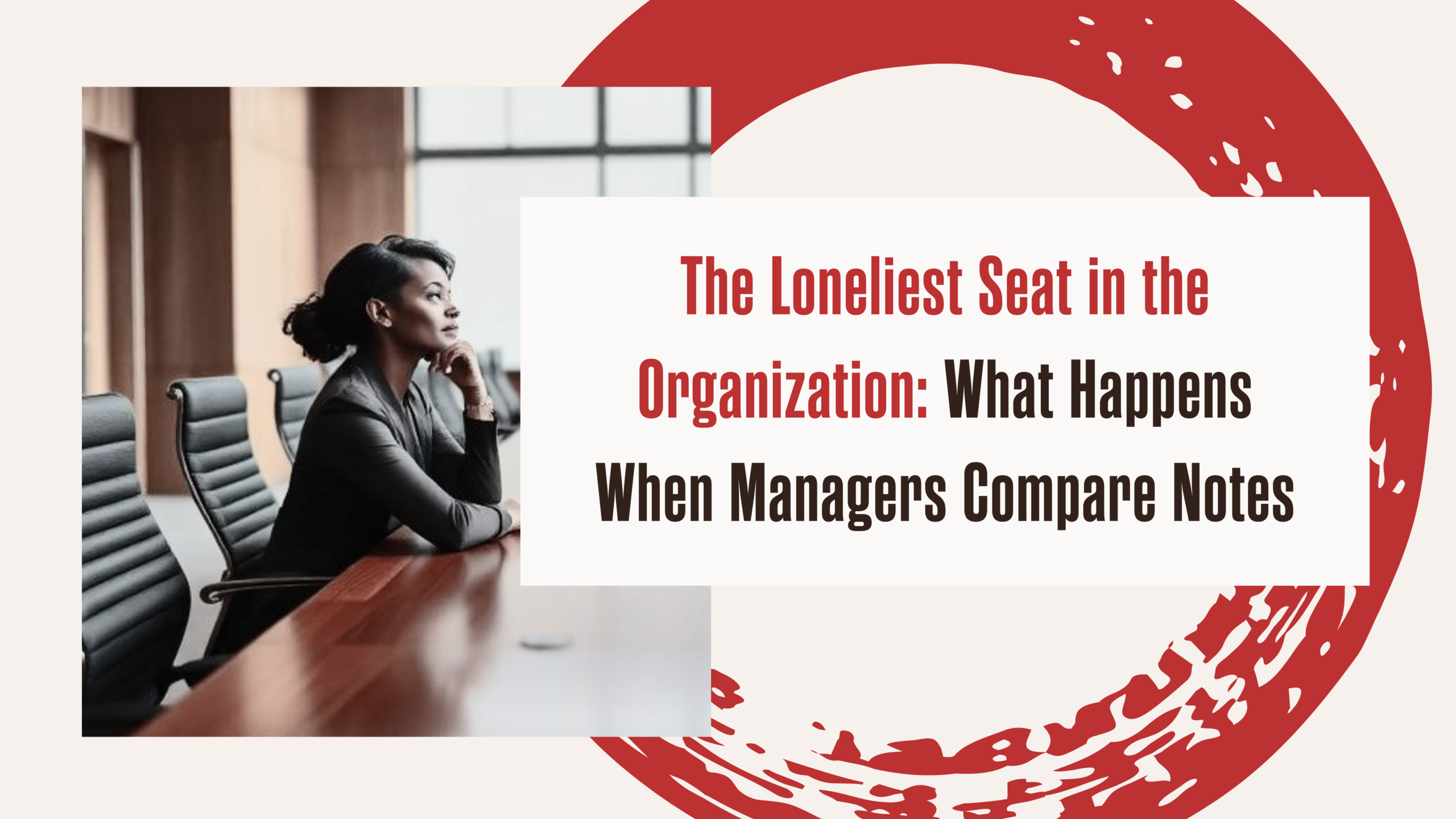
There’s a particular kind of isolation that comes with being a manager.
It’s not that managers are alone. Usually, the opposite is true.
They’re surrounded by people all day.
Their team needs them. Their boss needs them. Customers need them. Other departments need things from them. Their calendar is full, their inbox is worse, and somebody is almost always waiting on an answer.
And yet, a lot of managers are doing the hardest parts of their job largely by themselves.
Individual contributors usually have a natural peer group. They work alongside people doing similar work, facing similar challenges, and operating at roughly the same level of the organization. Senior leaders tend to have something similar. There’s usually an executive team, a leadership meeting, or some other regular place where they compare perspectives and work through issues together.
Managers often have neither.
They may technically have peers across the organization, but their actual work tends to keep them inside their own team or function. The operations manager is solving operations problems. The sales manager is focused on sales. The HR manager is managing an entirely different set of pressures.
They can spend years working twenty feet apart and almost never have a meaningful conversation about what it actually feels like to manage.
That matters more than I think we realize.
Because one of the most common things I hear when managers finally get into a room together and start talking honestly is some version of:
“Wait. You too?”
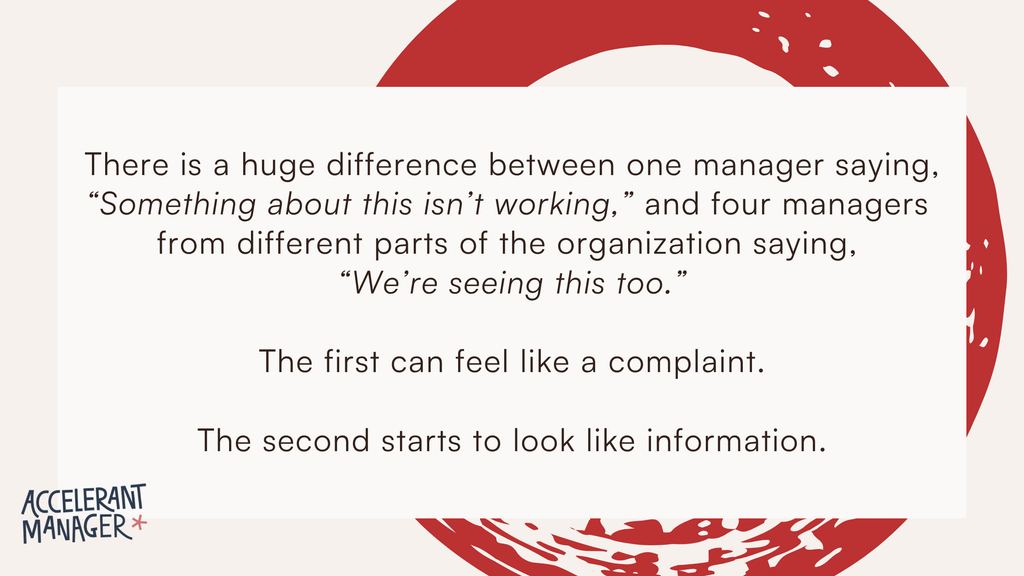
Someone describes a frustration they’ve been carrying around for six months, quietly assuming it was unique to their team.
Another manager recognizes it immediately.
Then another one does.
What felt like an individual problem suddenly starts looking like an organizational pattern.
And that changes things.
There is a huge difference between one manager saying, “Something about this isn’t working,” and four managers from different parts of the organization saying, “We’re seeing this too.”
The first can feel like a complaint.
The second starts to look like information.
That’s one reason peer relationships matter so much in the middle. They aren’t simply emotional support, although that matters too. They’re a way of testing reality.
Is this actually a problem?
Is it happening somewhere else?
Am I missing something?
Has somebody already figured this out?
Is this worth carrying upward?
Without those conversations, managers have to answer those questions alone.
And when the issue is politically sensitive, incomplete, or difficult to explain, being alone with it makes silence a pretty reasonable option.
If I’m not sure whether what I’m seeing is real, I may wait.
If I don’t know whether anyone else is seeing it, I may wait.
If raising it could make me look negative, resistant, or incapable, I may wait even longer.
Then eventually the thing either goes away...
or gets big enough that nobody can ignore it anymore.
We tend to talk about collaboration as something managers should create for their teams. But I think organizations should be asking another question:
Who are managers supposed to collaborate with?
Not just on projects or logistics.
Who helps them make sense of what they’re seeing?
Who challenges their assumptions?
Who says, “That’s happening here too”?
Who helps turn a private hunch into a recognizable pattern?
Because managers rarely lack information.
More often, they lack corroboration.
And maybe one of the simplest ways to unmute the middle is to stop leaving everybody in it to figure things out alone.