One of the most underappreciated parts of a manager’s job is translation.
Not language translation, obviously. Organizational translation.
Leaders make decisions at one altitude. They’re looking at budgets, timelines, strategy, growth, risk, and what the organization needs six months or two years from now.
Employees experience those decisions at another altitude entirely. They experience the new process that adds three steps to something that used to take one, the staffing decision that means everybody is carrying a little more, or the new software that technically works but somehow makes the work harder.
And sitting between those two realities is the manager.
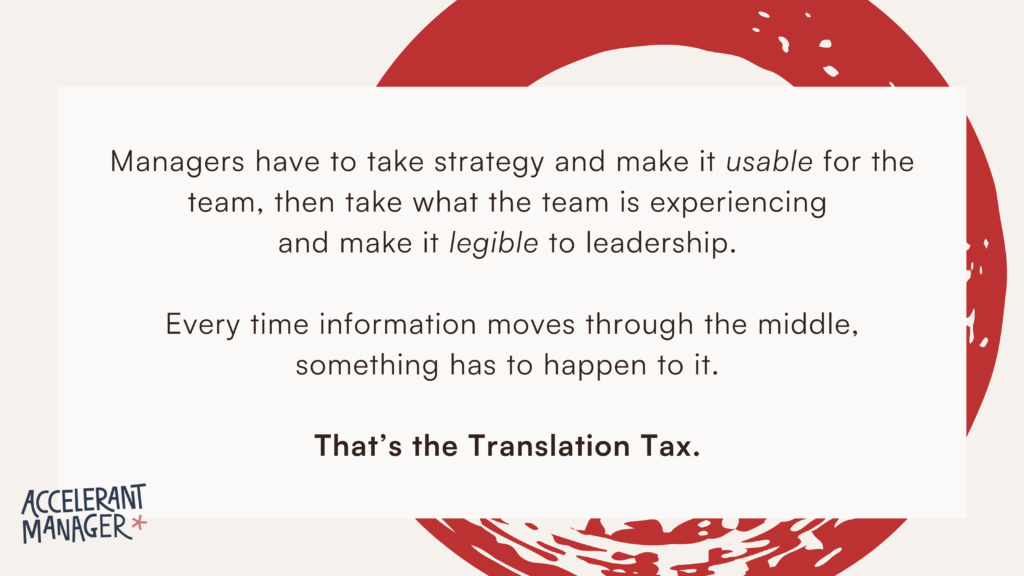
Managers have to take the strategy and make it usable for the team, then take what the team is experiencing and make it legible to leadership. That sounds simple enough, but every time information moves through the middle, something has to happen to it.
Tactical details have to be compressed enough to matter strategically. Strategic intent has to be unpacked enough to matter practically. Context gets added. Emotion gets filtered. Language gets softened. Priorities get interpreted.
All of that takes time and energy.
I’ve started thinking about it as a translation tax.
And like most taxes, you notice it most when it starts getting expensive.
Managers still have everything else to do. They’re running meetings, managing performance, answering questions, dealing with customers, solving scheduling issues, covering gaps, coaching employees, putting out fires, and trying to get their own work done somewhere in the margins.
When the translation tax gets too high, managers start making choices about what is worth carrying. And the first things to disappear usually aren’t the big problems.
Big problems travel pretty well. A missed target gets attention. A resignation gets attention. A customer escalation gets attention. A blown deadline definitely gets attention.
The things that get lost are the smaller signals: a process that is starting to frustrate people, a team member who seems a little less engaged than they used to be, a workaround that everyone has quietly started using, or the same complaint showing up in three different conversations.
Nothing is on fire yet.
Which is precisely why it matters.
Managers often see those signals long before anyone else does. I’ve watched this happen in culture assessments over and over again. Leaders will see a surprising result and wonder how part of the organization could possibly be experiencing something so differently.
Then you look at the managers.
They usually aren’t surprised. They know. They may even know exactly what is creating the difference.
The information wasn’t missing. It just never made the trip.
That should cause us to reconsider something. We tend to think of managers as the people responsible for getting information to employees. Maybe we should be equally interested in their ability to get information from employees back into the organization.
Because one of the most valuable things a manager can give a leadership team isn’t another status update. It’s an early signal. A pattern leadership doesn’t have a name for yet. Something that isn’t quite a problem, but might become one.
The thing that is still cheap to fix.
Which makes me wonder whether we’ve built enough room for managers to do that work.
Not simply: Do we tell our managers to speak up?
But:
Do we have a way for the small stuff they notice to travel before it becomes the big stuff we can’t ignore?
Because by the time everybody can see the problem, the middle probably saw it a long time ago.